Showing posts with label Opel. Show all posts

July 28, 2010

Opel GT.

In an effort to give its car lineup a more youthful image, Opel (named after the company's founder, Adam Opel) started working on the GT in the early 1960s. Opel reaped the fruit of its labor in 1965 at the Frankfurt Auto Show with a concept car called the Experimental GT. The production GT, which bowed in 1968, took some styling cues from the 1965 concept and blended them with bits and pieces from the Opel Kadett parts bin. The aerodynamic body was built at Brissonneau and Lotz in France and has been accused of too closely resembling the Corvette Sting Ray of the same era. This forty year old debate is best left untouched as it is mostly subjective.

Contributing to the GT's sleek style are its pivoting headlights. Rumor has it these headlights were part of the design to meet US Department of Transportation regulations: with them the GT can wear a low, aerodynamic hood but still meet the height regulations for headlights. They turn on via a big lever located on the center console which requires a notoriously large amount of effort to activate.

In Europe the base GT was powered by a meager 1078cc four cylinder, though buyers could opt for the Opel Rekord's 1897cc. Deemed too anemic few 1078cc GTs found homes and Opel phased out the engine in 1970. To fill the bottom-level gap the 1078cc left in the GT lineup Opel offered the GT/J, a variant powered by the same 1897cc but with less standard equipment, thus cheaper. The engine transmitted power to the rear wheels through either a four speed manual or a three speed automatic. Vacuum-assisted front disc brakes and rear drum brakes offered effective braking without requiring the driver to put all his weight on the pedal.

The GT sold fairly well because it was a lot of car for little money: about $3,500 in Vietnam War-era dollars. For weight distribution reasons the engine was located behind of the front wheels. Marry that to a responsive, non-assisted steering and you get a nimble little car with a point-it-where-you-want-to-go handling. The GT's aerodynamic body was designed in a wind tunnel, something not common in the 1960s, and could boast a top speed of approximately 115 miles per hour. To put this in perspective, a 1969 Mustang with a 351 V8 maxes out at about 119 miles per hour with almost three times the engine displacement.

"A lot of car" stops with the driver since the GT has two seats and no trunk to speak of. That isn't an exaggeration for how small the trunk is, it literally has no opening trunk. Instead it has a tiny area behind the seats where the driver and passenger can attempt to store their groceries.

Overall the GT proved to be a bargain if one was looking for a fun, affordable personal car. If someone wanted a fun, affordable car to enjoy with their kids, the GT didn't fit the bill.

Approximately 70% of the 103,463 GTs built took a ferry to the US where they were sold through Buick dealers. The example below was photographed in a Salt Lake City junkyard.

The GT's interior. Close observers will notice the headlight lever, further up from the shifter on the center console:

As a side note, have a look at our Facebook page to find photos that aren't in these pages or to discuss some of the cars we feature on this site.

March 25, 2010

Some "American" cars.

Many so-called "American" cars have been made over the years that just weren't American at all. Most have been re-badged offerings from Toyota, Mitsubishi, Daewoo, Kia, or Hyundai. Rarer though, are the ones that source their heritage to Europe. So, let's have a look at a couple of these European-American automobiles (in no particular order):

Hudson / Nash Metropolitan (1953-1961)

aka
Austin Metropolitan


Nash-Kelvinator saw the American desire for smaller cars -particularly marketable towards women - beginning to make an appearance. With the introduction of the VW Beetle to the US market, they didn't want the Yankees to be left out. They embarked on a plan for a small and inexpensive personal car. Nash decided that building such a vehicle from scratch wasn't going to be cost effective and eventually teamed up with Austin-BMC of England to do the work. The car would be manufactured there using a variety of Austin bits, including the B-series 1.2 and later 1.5 liter engines. Several exterior variations occured through the years, though essentially they maintained the "Nash" family look. Though produced in the UK, less than 2,000 of the nearly 10,000 Metropolitans were sold there, and only the earlier models carried an "Austin" badge. Though sales were not bad, Nash ended production of the car due to internal competition from the AMC Rambler, which was significantly larger and not much more expensive than it's diminutive English cousin.

Plymouth Cricket (1971-1973)

aka
Hillman Avenger


Back in the days when Chrysler was actually buying-out companies rather than trying to stay alive, they acquired the Rootes Group of England. During that time, the Hillman Avenger saloon and estate was developed and sold under a variety of names throughout the world. Notably, even as a Volkswagen 1500 in Argentina.
The English market looked upon the Avenger favorably and so, in 1971 it found its way to American shores badged as the Plymouth Cricket. Conveniently, being of Anglican decent, it used SAE fasteners and the 'Coke bottle' styling fit with the rest of the Plymouth range. Unfortunately, it was also rather unreliable, underpowered  (70 hp from the 1.5L engine) for American tastes, and had a tendency to rust rather badly. By 1973 Chrysler gave up on the Cricket and the final model year was simply to dump the remaining stock.

Dodge Omni / Plymouth Horizon (1978 - 1990)

aka
Chrysler Sunbeam / Simca Horizon / Talbot Horizon


Known internally as the "C2", the Simca division of Chrysler Europe somewhat unwittingly produced a true "World-Car". The 1977 launch of the Chrysler Sunbeam and Simca / Talbot Horizon from Chrysler Europe came at a time when the American counterpart was facing real trouble as a result of the fuel crisis. The decision was made to bring the new design Stateside. The US cars were in fact American built, but little about this car was American at all. The European versions utilized Simca sourced drive-trains, whereas in North America, a Volkswagen manual transmission and 1.7 liter engine was used initially though they sported a Chrysler-designed head (complete with traditional Mopar valve clatter). The VW engine was used until 1983 and was then replaced with a 1.6 liter Peugeot/Simca unit. Eventually the "L-body" American versions would see a variety of engines including a two turbocharged units from Chrysler itself - some Shelby versions even! The American cars also utilized different suspensions - A pity considering Europe got a Lotus-tuned version of the Talbot. Chrysler Europe was sold to Peugeot for $1.00 in 1978 amidst horrible monetary hemorrhaging - the same year the car began to roll off US production lines.  The Franco-American hatchback met its demise in 1990, four years after the PSA group allowed the sun to set on the Horizon overseas.

Pontiac LeMans (1987-1993)


aka
Opel Kadett E / Daewoo LeMans / Vauxhall Astra MkII


Opel Kadetts have been a major seller throughout Europe for decades as an affordable economy car. Beginning with the "D" variant, the Kadett became front-wheel-drive. The "E" variant continued using the "T-Platform" of the "D" but with updated aerodynamic fast-back styling. At best, this, the last of the Kadett evolution, was "crappy". Nevertheless, GM never lost an opportunity to make an easy buck and the rights were sold to Daewoo of South Korea. At the same time the decision was made to have Daewoo produce the Kadett for the North American market under the rather presumptuous "LeMans" badge. A sedan was also made with a 2.0 engine and a wheezing 96 hp. The end result was perhaps one of the General's worst offerings to date. The horrid build quality killed the car even in it's "home" Korean and German markets and it provided a less than stellar book-end to the Pontiac LeMans series of performance cars.

Cadillac Catera (1997-2001)


aka
Opel Omega B


The "Caddy that zigs" was more like the "Caddy that gags". Intending to appeal to a more youthful market with the Cadillac brand, the Catera promised performance and handling like that of a European sport-sedan. Well, they were almost there when they chose the Opel Omega sedan as the basis. Though "sporty" is up for considerable debate. The car was rather 'lame' in terms of excitement and just down-right bad in terms of quality. Numerous issues plagued the German built Cadillac from unacceptable tire wear due to suspension settings to complete failures of its L81 V6 (a unit which would plague numerous GM-built Saab models as well). Not to mention the fact that the car's "styling" was more like a gaudy patterned polo shirt than the cheap suits of other Cadillacs from the era. In 2001, poor sales led to the Catera's death and it was the final guise of the Omega B to be offered after European sales ended in 1999.

We could of course go on to discuss more; the most recent Pontiac GTO, the Saturn Aura and Astra, and even the latest Chevrolet Malibu. But then really, havn't we all heard enough about GM lately? It of course will also be interesting to see what Fiats make it here in the coming years via Chrysler's lineup. Ford is of course absent here, as they have long had a significant European presence. While occasionally some make it here, I think it's safe to say the Focus, Cortina, old Xr4ti's, and so-on need not be grouped with the above examples.

January 29, 2010

Hillman Husky.

As many of you guessed correctly the mystery car is a Hillman Husky. We'll post another mystery car soon but in the meantime, have a look at other cars rotting in the same Utah junkyard as the Husky.
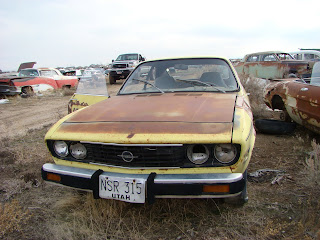
The Opel Manta was launched in 1970 and production of first generation cars like the one below stopped in 1975. Buick dealers sold Opels on the U.S. market and the Manta could be ordered with a 1600cc or a 1900cc.

Launched in 1961, the Renault Floride (or Caravelle in the U.S.) sat on a Dauphine platform and for better or worse used the Dauphine Gordini's Ventoux engine in 845cc form. The Renault 8's 1108cc replaced the Ventoux in 1965 and gave the Floride a much-needed boost in power. Production stopped in 1968. (As a side note, some early Renault 4s used a standard Dauphine engine bored out to 845cc; despite having the displacement they were different engines.)

The Citroen DS needs no introduction or explanation; besides, it's already been covered in these pages. This is an early DS19 model.

Last one, a Mercedes-Benz w110 190D. As its name implies it uses a 1900cc four cylinder diesel that churns out 55 horsepower.

February 8, 2009

The Golden Age of Automotive Advertising


Ok, it's winter and to be honest, there's a bit of a lack of things to post on here lately. As a result, we've come up with the "Great Automotive Failures" editorials and other such things for your enjoyment. But now for something completely different (sort of)...

The 1960s and 1970s had some truly 'great' automotive advertising. Many of them unashamedly grabbed males' attention from a gut level (or maybe lower) without the use of too many things like words or information. Let's have a look, shall we?

British Leyland had a pretty good grasp on this concept:


The TR-7 was a little scary. I don't blame her for hiding.


Ah, the 1970s was a colorful time indeed. Driving a boxy European economy car, combined with loud apparel is sure to get you some girls...


I'm assuming this girl's RO-80 had a major rotor seal failure right where it's parked. Might as well get a tan while waiting for the tow truck.


Before Volvo's became boxy:


And perhaps best of all, are these fine examples here...

Beautiful landscape in this Zastava ad. 
 
... and then they just stopped trying. I believe they taped a photo of the car to a page out of an Eastern Bloc adult magazine and went to press...


Not a car ad, but still, same concept. 


December 15, 2008

Practical European style?


Here's a relatively rare one... a Volkswagen 412 that I spotted in a Dallas-area junkyard. A fairly rare sight even when new, the 412 was an update of the 411, neither of which met much success in the United States. Sources suggest that about 110,000 Type 4s (411 and 412) were sold in the U.S. during a four-year model run, though I wasn't able to discern just what years were imported.

Unfortunately, I failed to get much more information out of this 412 since it reeked of a filthy, indescribable scent. Obviously the victim of a flood, it is nonetheless a quite straight, rust-free example of a very, very rare - and very practical - VW.


And if that wasn't enough, I also spotted this even rarer Opel Kadett three-door wagon. First, why can't anyone offer this bodystyle in a new car? The closest I can come up with is the Volvo C30, but it has about as much storage space as a shoebox. This three-door estate was also in remarkably solid condition despite last being registered in 1982. Sadly, these cars weren't sexy when new - and they're not much sexier today. Still, they're affordable and practical classics that should be kept on the road.

January 10, 2008

"Behind the Curtain"


Off and on for the last 5 years I've worked for a local foreign car mechanic in Erie, PA named Wolfgang. As his name would suggest, he really is a stereotypical German mechanic. He's a notorious pack rat and has been collecting cars, car parts, and parts cars for the last 30 years. In his shop, he has an area he refers to as "behind the curtain" (though to be correct, one has to say 'behind ze curtain') This is where he keeps most of the 'good' junk. It's really just a big room sepparated from the main work area thats filled with Mercedes, VW, Audi, Volvo and Jaguar parts among other things. Wolfgang's entire shop could take up many posts in this blog, so at this point, I'm only going to show these pictures of some of the non-running cars stored in there:

The Audi 5000 Quattro Turbo that's burried under these boxes, is actually pretty clean aside from its thick layer of dust. The story goes on this car that it had a major front suspension issue (hence the missing wheel) and the customer opted to give Wolfgang the car rather than pay for the costs. Last registered in 1995. This car could be cleaned up, repaired and be rather nice, unfortunately late 80's Audi sedans haven't made much of an impact on the collector car market and it's probably not worth the effort.

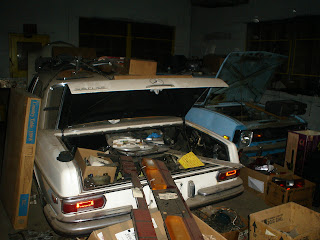
This 1971 Opel Kadett Combi was last registered for road use in 1992. Since then, it's been a semi-permanent fixture in the back room. It cargo space is filled with parts for other cars. It may seem to be in a rather sorry state - and essentially it is, but it really wouldn't take much to get it running and driving again. The body appears to be pretty solid and, to quote the name of this site, it ran when parked.


Also of note is this early 70s Mercedes Benz 280 SE. It's in need of some body work, but the rest of it appears to be pretty decent. It sports a red MB-Tex interior, and is powered by the 6 cylinder engine. This could definately be a worthy canditate for a modest restoration. Im not aware at the moment how this Benz came to rest in the back room. As you can see, it's currently primarily a storage box and table.