

Carlo Abarth is well known in the racing world for the exhaust systems that bore his name, the cars he designed and raced and for his work modifying Fiats 500s and 600s into the precursors of hot hatches such as the Golf GTI: the concept is similar, a big engine in a small, mass produced car.
Simca is well known in European competition for their 1000 Rallye and 1000 Rallye 2. But the idea of making the boxy, rear-engined Simca 1000 go fast didn’t start with the 1000 Rallye in 1972, it started with Carlo Abarth in the early 1960s.
Abarth chose the Simca 1000 as his next project partly because it was newer than the Fiat 600s and 500s (introduced in 1955 and 1957 respectively) and the idea of racing them apparently hadn’t crossed the minds of many other folks. Another reason is that when Simca introduced the 1000 in 1961 it became immensely popular on the French market. It was well-designed, reliable and benefited from very decent built quality. Abarth saw the same potential in the little Simca and started drawing out ideas. With the green light from Fiat, which created Simca in 1934 and still owned it at the time, a hundred cars were shipped to the Abarth factory in 1961 to go in for modification. The cars debuted in the 1962 season and proved successful in races across Europe.
Abarth wanted to take it a step further and make these cars available to the public. They were to be part of the Simca lineup and sold through Simca dealers. In 1963 he introduced four variants of the Simca 1000: the 1150, the 1150 S, the 1150 SS and the 1150 Tipo Corsa. The standard Simca 1000 used a 944cc engine, Abarth bored it out to 1137cc, which pushed the base 1150 to 55hp. Other modifications included 13” rims (instead of 12"), disk brakes all around, a tachometer and an oil pressure gauge. The 1150 S saw its power output increased to 58hp but the biggest change can be seen just by looking at it: like on some Fiat-Abarths the radiator was moved to the front which called for the installation of a grille. The 1150 SS and the 1150 SS Tipo Corsa shared this radiator setup while the base 1150 retained the rear-mounted radiator.
The 1150 SS logged a healthy 65hp and saw its compression ratio increased to 9.5:1. The ultimate evolution was the 1150 SS Tipo Corsa. Thanks in part to a 12:1 compression ratio, Abarth managed to get an impressive 85hp out of the engine, a fair amount when you take into account that a standard Simca 1000 puttered along with 40hp under the rear bonnet.
At this point you may be wondering why these cars didn’t create serious competition for the Renault 8 Gordini in the European car market. The explanation lies in a detail that I’ve omitted until this point: these were all built as prototypes. Chrysler took over Simca from Fiat in 1963 and decided to pull the plug on the project, focusing instead on bigger sedans. Consequently very few Simca Abarths were built and they’re unspeakably rare, though a couple of examples have survived.
Below are some period photos I've come across. If you can't click on the photos and want a high-resolution image (for this article or any other), email us at ranwhenparked -at- hotmail -dot- com, tell us what you'd like and we'll send it to you.


 As many of you guessed correctly the mystery car is a Hillman Husky. We'll post another mystery car soon but in the meantime, have a look at other cars rotting in the same Utah junkyard as the Husky.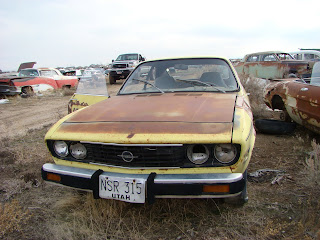

 Launched in 1961, the Renault Floride (or Caravelle in the U.S.) sat on a Dauphine platform and for better or worse used the Dauphine Gordini's Ventoux engine in 845cc form. The Renault 8's 1108cc replaced the Ventoux in 1965 and gave the Floride a much-needed boost in power. Production stopped in 1968. (As a side note, some early Renault 4s used a standard Dauphine engine bored out to 845cc; despite having the displacement they were different engines.)


