Showing posts with label Japanese. Show all posts

May 30, 2011

Developing the death-proof car.

As a result of rising death rates in auto crashes, the U.S. Department of Transportation launched the Experimental Safety Vehicle program in 1970. The program was intended as a way for various automakers to learn more about both passive and active safety in cars and apply that knowledge to production cars in the next ten or so years.

It consisted of building prototypes that met certain requirements: they had to keep passengers alive in a 50mph crash into a solid barrier, withstand side impacts at 30mph, protect the car’s occupants in a 75mph rear end collision, and survive two complete rollovers at 60-70mph.

Some of the guidelines revolved around handling so manufacturers couldn’t simply turn an economy sedan into an armored tank that destroyed everything in its way. The prototypes had to stop from 60mph within 155 feet on a dry road, accelerate from 30 to 70mph in less than 12 seconds with a 60% load and make an abrupt 180 degree turn at 70mph without rolling over.

The test cars were organized by weight classes: 1500 pounds, 2000 pounds, 2500 pounds and 4000 pounds. Part of the guidelines was, of course, that the cars actually respect the weight limit in each class, something most of the participating manufacturers had a hard time doing given the extra equipment they bolted on to each car.

These prototypes were remarkable in both the effort and resources put forth to develop and build them but also in the far-fetched ideas that some manufacturers came up with in order to supposedly make a car safer. Popular Mechanics hit the nail on the head when in June of 1972 they observed that “the world may never want to place an ESV in production, but we sure want the answers the cars can give us.”

We picked a few ESV prototypes to take a look at but it’s far from an exhaustive list. Looking at all of them would take ages; lots of manufacturers took part in the program including Opel, Renault, GM and Nissan.

American Machine & Foundry AMF 2

AMF has manufactured a vast variety of products: bicycles, tennis rackets, golf clubs, snowmobiles and even Harley Davidson motorcycles, just to name a few. Conspicuously absent from that list are cars, but they gave the ESV program a shot anyways. Their prototype was part of the 4000 pound category but weighed a whopping 5,791 pounds. It had a steel body with aluminum bumpers that had a thirty inch (!) travel. Rear visibility was assured by a submarine-like periscope, visible on the roof.

Like many other ESV prototypes it had airbags to protect the occupants and AMF took it further by adding automatic fire extinguishers. It is remembered as one of the best ESVs built by an American company.

Fiat ESV 1500

Fiat’s ESV for the 1500 pound category was one of the three the company built in the early 1970s. The other two were in the 2000 pound and 2500 pound category, respectively.

To develop the 1500 pound ESV Fiat used crash test data from the 500. The prototype uses a 500 running gear with a slightly bigger engine to counter the added weight, though the use of 126 parts is noticeable as well. This one met most DOT requirements for its weight class including fire protection, safe driving in foggy weather and pedestrian safety. The requirement it didn’t meet was the weight – it weighed a little over 1700 pounds in a weight class limited to 1500 pounds.

Ford ESV

Unlike a lot of other ESVs Ford’s prototype was based entirely on an existing production car, the LTD. Compared to the car found on dealer lots, the LTD ESV had a longer hood and a shorter trunk. Like the AMF above it was part of the 4000 pound category and also like the AMF, it weighed considerably more: the Ford tipped the scales at almost 5,300 pounds.

Compared to a stock LTD the brakes and suspension were modified to comply with the DOT’s handling requirements, including the addition of an ABS system that acted only on two wheels. The bumpers were hydraulically retractable to withstand a 10mph crash.

Both Ford and GM charged the government $1 for the development of their ESVs.

Honda ESV

Honda’s ESV was not an ESV in the true sense of the term. Instead they tried to build a mass-produced car to ESV standards, the same path that Ford followed. Ford did much better than Honda but they were starting with a bigger and heavier car; Honda was starting with a Civic. Honda strengthened the Civic’s body all around, including the door pillars to increase protection in a rollover. The engine was the same 55hp unit found in the production car.

Because of miscellaneous setbacks revolving around the Civic’s tiny size, the prototype took a year longer to complete than the other ESVs.

Mercedes-Benz ESF 22

Mercedes was very active in the ESV program: the ESF 22 was their third prototype after the ESF 5 in September of 1971 and the ESF 13 in 1972. First two prototypes were based on a w114 250 sedan but the ESF 22 was based on the w116 450 SE.

The ESF 22 used ABS brakes all around and experimented with airbags. Although the ESF 22’s long hood kept occupants alive even in the event of a 40mph crash against a solid structure, Mercedes’ prototypes did not comply with all of the DOT-mandated requirements in the program. Mercedes built a fourth and final one, the ESF 24, and called it quits.

MG SSV 1

This was another small car entry. MG started with a B GT body and added equipment such as a heads up display for the speedometer, airbags, big rubber bumpers and a self leveling suspension that would be later outlawed by DOT.

MG drunk driver-proofed the car by having a little colorful sequence show up on a screen when the key was inserted. Before the car would start, the driver would have to reproduce the sequence. The driver had three tries; if by the third the correct sequence had not been entered, the car would be impossible to start for an hour. The idea was that if someone was drunk enough, they wouldn’t be able to reproduce the sequence in the right order.

One of the few features from the SSV 1 to make it on a production MG are the huge rubber bumpers, though certain MG owners have reported seeing a sequence of flashing lights on the dash followed by their car not starting.

Toyota ESV

Toyota took a smaller approach to the ESV prototype: they developed a 2500 pound two-seater coupe. It was powered by a 1700cc mated to an automatic transmission, seen as safer than a manual transmission since it was run by a computer and not a human.

The prototype was packed full of electronics, including a system that adjusted the brightness of the headlight based on the car’s speed. The car also had radars to scope out the road ahead for obstacles. If one was found too close and the radar judged that a collision was unavoidable, it would send a signal to deploy the “gasbags”. The car also used what Toyota called failure warning board, a sort of on-board computer that monitored brake fluid level, engine oil level, etc.


Volkswagen ESVW-I

Staying true to Volkswagen tradition, their ESV had a 1700cc rear-mounted air-cooled engine. It developed 100 hp and was fully compliant with U.S. emissions.

Interestingly enough Volkswagen opted not to use airbags. Instead, they had seatbelts that automatically restrained passengers in the event of a crash thanks to gas-fired pistons. The car was equipped with what Volkswagen called a “silent co-pilot” system that calculated how much crosswind was hitting the car and from what side and electronically compensated the steering for it.

On the outside the bumpers didn’t stick out near as much as other prototypes and period Volkswagen literature bragged that their ESV had a “nearly normal” appearance, as opposed to other cars in the program.

Volkswagen built a second ESV in 1974, the ESVW – II, based on a first generation Golf/Rabbit. They exited the program soon after because they realized that the safety features would be too costly to implement in a production car.

Volvo VESC

Volvo has always been a leader in auto safety so it shouldn’t come as a surprise that they started developing the VESC in 1969, a full year before the DOT started the ESV program. With that said it was not developed with any of the program guidelines in mind but excelled anyways. It weighed a few pounds shy of 3,200 pounds.

The bumper had a seven inch travel distance to absorb shock and the engine was designed to get pushed under the floor in the event of a front collision, something Mercedes introduced on their W168 A-Class in 1997. To effectively stop the car ABS was fitted on all four wheels. On the inside, occupants were protected by both front and rear airbags.

February 17, 2011

A quick look at the Bertone Freeclimber.

BMW fans around the world were shocked at the launch of the X5. A BMW SUV? Sacrilege! What few people knew is that a BMW engine powered a luxury ute long before the X5: does the name Laforza ring a bell? It looked like a Fiat Uno on steroids and was sold in the US with a Ford V8 but the precious few sold in Europe had BMW engines starting in 1989. There was also another, lesser-known, luxury ute with "BMW" written on its valve cover.

The story starts in Italy in the early 1980s. Bertone was building Ritmo convertibles and picked up X1/9 production after Fiat axed the model from its lineup. All was well for a few years but by the late 1980s Americans had declared the X1/9s outdated and Europeans preferred the Golf Cabriolet over the Ritmo, leaving Bertone out of work. In need of a new project, they decided to enter the growing luxury 4x4 market.

Developing a new car from scratch would have been too expensive so they started with a Daihatsu Rocky, a small, boxy and rather basic 4x4 that was virtually unknown outside of Japan.
How does one turn a relatively plain Japanese SUV into a luxury 4x4 fit for the European market? The first step was to give it a more upscale look. Since this is Bertone we’re talking about one would expect a sleek new body but with the exception of a new grille, the exterior was pretty much identical to when it left the Daihatsu factory.

The interior was spruced up with new instrumentation, leather seats and a Bertone logo proudly featured on the leather steering wheel. It was better equipped than the Daihatsu: power door locks came standard and air conditioning was offered as an option. Buyers could order it with a hard top and/or a soft top.

Under the hood came the big surprise: the Freeclimber was available with one of three straight six engines, all sourced from BMW. First on the menu was the M20, displacing either 2.0 or 2.7, and those who wanted a set of glowplugs could choose the M21 2.4. All three engines were mated to the stock Daihatsu transmission. To increase off road capacity the rear suspension was modified and it had a limited slip differential. They finished the transformation with specific wheels.

The whole package had a base price of 167,937 francs in 1990. That same year a two-door Range Rover started at 197,200 francs, and a Jeep Wrangler could be had for 115,517 francs.

Assembled in Italy, the Freeclimber was imported in a small handful of European countries including France and Germany. France’s importer was AndrĂ© Chardonnet, who also imported Autobianchis and Lancias until 1988 and Maseratis until a little later. In Germany they were sold through the Daihatsu network. Only 2,795 Freeclimbers found a home from 1989 to 1992.

Daihatsu redesigned the Rocky for 1993 and logically, Bertone redesigned the Freeclimber. They also renamed it, calling it simply the Freeclimber II. It used the same chassis as its predecessor but looked different aesthetically thanks to bigger fender flares, standard OZ alloys and a body-colored grille. The straight-six engines were dropped, replaced by BMW’s 1.6 M40. By the time it was launched official imports had stopped in France and Germany so most were sold in Italy, where a few even went to the Carabinieri.

In 1995 Bertone landed a contract to build Fiat Punto convertibles and Opel Astra convertibles. Since the Freeclimber II hadn’t been a huge success they dropped the model at that time after building 2,860 of them. The Daihatsu Rocky soldiered on until 1998.

Below: a soft top Freeclimber.


Below: Freeclimber press photos showing the hard top model.

Below: a Freeclimber II press photo.

February 9, 2011

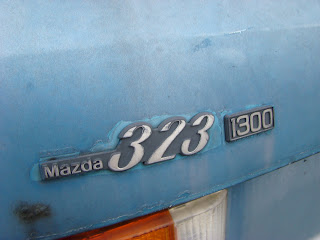
323.

As one reader guessed correctly the mystery car from yesterday is a Mazda 323, built from 1977 to 1980. Judging by the license plate on this one, it is likely a 1979 model. These were sold throughout the world under various names, including Familia and GLC (Great Little Car).

November 4, 2010

Moderately Priced Mid-Engined Cars


Automotive manufacturers have understood the advantages of placing a car's engine in the middle (or, behind the driver and ahead of the rear wheels) for some time. By placing the engine there, the weight balance of the car can be made much more even over the front and rear axles. This allows (in most cases) for superior handling over front-engined cars, which tend to understeer, or rear-engined cars, which tend to oversteer. Auto Union grand prix cars from the '30s, designed by Ferdinand Porsche, were some of the earliest examples of this configuration. At the time, it was considered somewhat unstable, but the greater advantages of mid-engined design were continually explored, perfected, and adopted in particular on racing cars by nearly all manufacturers. It was not until the 1960s that mass-production of a mid-engined road car would really begin.

Not all mid-engined cars have to be outlandishly expensive supercars like Ferraris or Lamborghinis. There are a few examples of these well balanced sporting cars that the "average Joe" can afford to purchase and enjoy, even as a starter classic. So, we have prepared a list of some moderately priced mid engined cars for the masses which can be had for under $20,000. Granted, in the long run, some can end up costing you much more, but let us start with the most affordable:


Toyota MR2 (1984-2007)


The Toyota MR2 has the great advantage of being affordable, fun, and reliable though to be honest, they're not exactly the most desirable of the lot here. Honestly, most people don't dream of some day owning a Toyota over say, a Porsche, Lotus, or nearly anything Italian. Nevertheless, they're a good starter sports car or easy-to-run weekend runabout.
The original MR2 of 1984 featured crisp styling as boxy as one could expect from a 1980s design. The car was designed in cooperation with Lotus and it's not surprising considering the car's light weight and excellent handling. Initially, a 1.6 L DOHC four-cylinder engine was mounted transversely behind the passenger compartment. While it wasn't exactly the most powerful engine in the world, it was quick and eager to rev.
By 1986, an optional T-top roof configuration was made available, adding some appeal to those desiring an open air experience. These early MR2s can be had for just a few thousand dollars (or less if they're an abused example in need of some care). Beware though - they are getting old and they are made in Japan - rust can be an issue.


In 1989, the MR2 went through a complete redesign with a more rounded and organic body. The car weighed a few hundred pounds more than its predecessor, though it also became more powerful, and even a 200hp turbocharged variant was available. Again, the T-top was offered. These Turbo models obviously cost a bit more even today, though finding a decent example for under $10,000 is not at all unheard of.


Finally, the last of the MR2s, the Spyder, marked a rather drastic change in direction from the previous two generations. Another complete redesign made the sporting Toyota a full roadster for the first time. The very successful Mazda Miata must have left them wanting a piece of the market. The "new" MR2 also lost the pop-up headlights of past models and also, several hundred pounds over the last generation. Once again, the model was light and very nimble, though only a 1.8 L four-cylinder was available, and alas, no turbo. To many, these are the best of the MR2s and since production stopped in 2007, they can be purchased quite cheaply from roughly $8,000 to $15,000.

Fiat X1/9 (1972-1989)


The Fiat X1/9 was a rather radical departure for the company known for its small economy cars and classic Italianate roadsters. The crispy body was styled by Bertone and the basic drivetrain was that of a Fiat 128 moved to the back. While initially, the X1/9 weighed in at roughly 2000lbs, the anemic 1.3 L four-cylinder was hardly a powerplant for a sports car, producing a wheezing 75hp and virtually nothing in terms of torque.
The car did have the advantage of a fairly stiff body, a removable top, and of course, good handling. Furthermore, it also had some luggage capacity, which is typically at a premium on mid-engined cars. Granted, I wouldn't choose one to take on a cross-country camping trip, but some weekend luggage would fit.
As Federal crash-test regulations increased, so did the bumper size as well as weight. Smog equipment further taxed the engine and decreased it to a down-right poor 63hp. By 1979, a larger 1.5L engine was fitted and added a little much-needed power. Fiat left the US market in 1982, and the X1/9 was marketed as a Bertone until 1987. World-wide production and sales of the car ceased in 1989.


While the earlier cars are a little better looking and lighter, later cars do have advantages in terms of a little more passenger space and better rust-proofing. Being Italian and from the '70s, rust is naturally a major concern when purchasing an X1/9. It's not hard to tune one to respectable performance provided local laws allow it. Fortunately parts are readily available as about 160,000 were made and it utilizes many standard Fiat parts. Finding a decent example may be difficult, but should only cost you well under $10,000. Be prepared though - it's Italian, and it will break.

Lancia Montecarlo / Scorpion (1975-1982)


The Montecarlo (or Scorpion to the US market) was originally intended as a big-brother to the Fiat X1/9. The Scorpion / Montecarlo, however, is larger and perhaps most importantly, more powerful. Unfortunately, the Scorpion was very short-lived in the US market (sold in only 1976-77), though a few Montecarlos have been imported. Unlike the 2.0L European counterpart, the US Scorpions were only sold with a 1.7L four-cylinder offering only 80hp. Still, the Pininfarina styled body is aesthetically more pleasing to many over the Bertone X1/9 and the weight nearly the same.
One unique feature of the Lancia design is the large retracting canvass roof. Though not all Montecarlos had this feature, all Scorpions did. Naturally, being Italian, build quality was always questionable, but you can't deny that the cars certainly have that Mediterranean flair.


As I'm sure one could expect, reliability and rust are the biggest problems with the Scorpion. Furthermore, these cars were notorious for easily locking the front brakes and creating a rather scary situation for the driver. It wasn't until after US sales stopped that Lancia simply removed the brake booster as a quick solution.
The Scorpion is a rather rare beast here in the States as only 1800 were made for the American market. If you find one, it's important to make sure the car has been well taken care of and is properly sorted out. If not, you could be in for the nightmare of your life. In spite of the car's relative rarity, prices vary considerably. A fixer-upper could run you only a few thousand - a restored example around $20,000 or more.

Porsche 914 (1969-1976)


Here at RWP, we're no strangers to the Porsche 914. In this writer's humble opinion, having grown up with these, it is one of the most under-rated sports cars ever made. The styling may take some getting used to for some, but the 914 seems to fit very well with the rest of the classic Porsche stable. The bodies were assembled by Karmann and were fitted originally fitted with either a VW-sourced "Type-4" engine, or Porsche's classic flat-6. When the 914 was introduced, it was largely applauded for its spaciousness, two trunks, removable hard top, and superb handling. If you opted for the 1.7 L flat-four engine, however, you'd be less than impressed with the performance. The 914-6, on the other hand, was fitted with the same 110 hp 2.0L flat-six as an early 911. The problem though, was the rather high price which fell just short of a 911T at the time. Not much of an "entry-level" Porsche in those respects.
By 1971, Porsche saw that the 914-6 was too costly and opted to drop it from the line. In 1973, a 95 hp (100hp outside of the US) 2.0L variant of the VW engine was offered and gave the car a good balance of performance and price. The base-model was uprated to a 75 hp 1.8L as well. These would be the first mass-produced cars with electronic fuel injection. The 914 was never really a "cheap" car, and lower-cost competition from Fiat, Datsun, and Triumph, for example, made the 914 rather hard to sell.
By 1975, big Federal bumpers and smog equipment did their best to kill the 914 like so many other imports. Sales dropped along with power (the '75 and '76 cars all had the 2.0 but were de-tuned for emissions) and the 914 ceased production.


Many 914s have been tastelessly and poorly modified to American V8s and/or fitted with body kits and other gaudy accessories. These should probably be avoided. 914s were often abused over their lifetime and a good, rust-free example can be tricky to find, but they're out there if you look - Porsche built nearly 119,000 of them. It's easy to hot-rod a VW engine and most 914s are old enough to get around emissions regulations. A '73 or '74 model is probably the most desirable, as they have a better shift linkage, smaller bumpers, and decent power. There are some well done 6-cylinder conversions as well. Expect to pay $10,00 to $18,000 for a nice 4-cylinder and an original 914-6 may run well over $20k. They're very reliable and VW parts keep running costs down, but be warned, anything with a Porsche part number is pricey.

Lotus Europa (1966-1975)


You could say that this is the one that started it all, in terms of mid-engined road cars. The Europa was the first "mass-produced" production car to have the engine in the middle (if you consider less than 10,000 units "mass"). Like earlier Lotus designs, the Europa used a steel back-bone chassis with a fiberglass composite body. Say what you will about the styling (some love it, I personally hate it), but it was certainly aerodynamic with a drag coefficient of 0.29. This, combined with a curb weight under 1,500lbs made for a very nimble car.
Power was sourced from the Renault 16's 1.5L four-cylinder and 4-speed gearbox and tuned to a respectable 82hp. in 1968, the S2 variant was introduced with several refinements over the original design. These are probably the most desirable of the early cars. Finally the 1.5L Lotus Twin-Cam engine became available in 1971 along with a change in the body. The rear "flying buttresses" were carved out a bit to make it easier to see out of the incredibly tiny car.


As far as practicality goes, there essentially is none with this Lotus. It's very small, hand-made in England and therefore likely to have build quality issues, and probably the most unsafe of this entire lot of cars. That being said, they're incredible fun. Values for these cars are rising, particularly for an early example or a Twin-Cam. Watch out for typical electrical gremlins and poor fiberglass repair that could literally leave the body coming apart at the seams. Lotus made relatively few of these, but they're still out there for $10,000 to $20,000+ if you can find them.

Lotus Esprit (non-V8s 1976-1996)


Lotus again employed the proven fiberglass body over steel backbone chassis design for the Esprit. The wedge-like design of the Esprit was also becoming somewhat of a Lotus trait in the era, referencing some of their racing cars' shapes. Like most of these early Lotus models, it has a bit of a kit-car feel to it, which some may not like. Regardless, the Esprit was another great "driver's car" in terms of its road holding and feel.
The earliest examples of the Esprit were powered by Lotus' own 2.0L "Torqueless Wonder" power plant driving the wheels through a Citroen SM transaxle. As you'd probably expect, these are the slowest of the Esprits, and probably the most prone to quality issues. The S2 had various improvements over its predecessor, though the engine remained the same. In 1981, a lightly re-worked Esprit, the S3, was equipped with a more powerful 2.2L Lotus-built engine. A turbocharged version also hit the market, finally adding some much needed "real" power.


In 1987, a less angular and stronger body was fitted to the Esprit. These cars mark the transition to the "modern" Esprits. Various trims and engine specifications were available throughout the 1990s and it actually seemed as if the design was finally coming into its own and shedding the 'kit car' image. Beginning in 1996, a turbocharged, all-aluminum, 350 hp V8 developed by Lotus found its way into the car. These are the fastest of the Esprits, but also the most expensive. In terms of being an "affordable" mid-engined car, they're a little too far off the chart.
Like anything, condition is a large factor in price with these cars. You can find an earlier model for around $10,000 or so, but unless you're willing to spend a lot on repairs, you may be better off finding a later S3 model that's been well taken care of. These can be had for under $20,000, but a really nice one can be significantly more. V8 models are usually well over $25,000.

Porsche 986 Boxster (1996-2004)


It hardly seems like it was so long ago that the Boxster was automotive industry front-page news. Porsche was having a hard time financially, and the 986 marked the beginning of a new era in Porsche's history. The completely new design was a significant departure from the line-up preceding it, which were cars all based on designs dating back to the 1970s or earlier. Porsche was no stranger to water-cooling by this period (924, 928, 944, 968, etc.) but this was the first time the company used it on typical flat-6 engine layout.
Everything about the Boxster was new, including the very method in which Porsche produced the car. To keep costs under control and therefore make the model a success, the Germans actually hired Toyota to advise them on production processes and parts sharing. The Boxster shared much in common with the 996 series '911' including styling cues such as the unique headlights. Perhaps realizing that their last attempt at an entry-level mid-engined car (the 914) was rather distant from the classic Porsche shape, the Boxster bore more than a passing resemblance to the legendary 550 Spyder.
At its debut, the Boxster could be purchased for just under $40,000 - a relative bargain compared to a 911 and even more so when one considers the arguably superior handling over its big brother. Granted, power wasn't as great - the 986's engine was initially a 200 hp 2.5L - but overall, the whole package was just what Porsche needed to revive the company. Boxsters sold faster than they could be built.
Some criticized the Boxster for being a little too cheaply built, particularly in interior quality. Early cars had issues with engine failures due to production flaws and as a result Porsche instituted a massive recall program. Most of these cars had entirely new engines fitted under warranty and are trouble free.


In addition to great handling and a full roadster layout, the Boxster, like the 914, has two trunks and therefore a considerable amount of luggage space for a car of this type. Like all Porsches, year-to-year changes are numerous, but perhaps most important is the fitment of a more powerful 2.7 L engine in 2000. Boxsters are perhaps the most common Porsches on the road today. Fortunately for those wishing to own one, prices of used models are fairly low. Certainly some have been abused, but a decent late-90s example can be had for a very resonable $10,000 or even less. Later models and "S" spec cars may run closer to $20k and a second-generation "987" series will be higher still.


Photos are not the property of RWP and we do not claim credit for them

October 19, 2010

You don't see these too often: Honda Acty


Japanese "Kei" class vehicles will occasionally pop up in the States for institutional use. Penn State has several for example. It's not often, however, that they appear for sale at your local Chevrolet dealer. (Alas, it's sold "As-is. No Warranty") This happy looking fellow is perhaps one of my personal favorites since I have a fondness for Hondas. This is a 2nd generation (mid 1990s) Honda Acty sporting "Real Time" four wheel drive and a 4-speed manual transmission driven by a 660 cc inline 3-cylinder.


It can carry 770 lbs of stuff... not bad.  I wonder if you can put a snow blower on the front...

Granted, it's probably horribly unsafe on the highway, but you could probably never find a way to register it. (though they can reach highway speeds which is perhaps the scariest part) Regardless, it would be fun to have one of these around the house for yard work, or even as the ultimate urban winter car. New, these sell for around $10,000 in Japan. No price was given on this example.

January 30, 2010

What Lies Beneath: Honda 4 Wheel Steering

Above: Early Honda 4WS prototype using two Accord front-ends sectioned together. Note the red tail/headlights.

In the late 1970s, Honda began researching the possibility of four-wheel-steering as a way of improving upon the basic fundamental design of the automobile. It was an ambitious project for a company, which, up to that point, had only been building cars for a decade or so. They recognized the advantages of having all four wheels steer a vehicle, though the issue would become more complex when choosing between a set of rear wheels that steers in the same or the opposite direction of the front set.
If the rear wheels steer in the opposite direction, the turning radius of the vehicle is reduced (in this case, about 3 feet) and tight-turns become easier to maneuver. However, same-direction steering allows for rapid changes in lateral movement - such as passing maneuvers - with far less actual rotation of the car's body.

Honda opted against picking one method or the other and engineered a mechanism to allow the rear wheels to steer in parallel with the front at slight steering angles, but opposite of the front under tight angles. A separate steering gearbox at the rear of the car performed the complex task of aligning the rear wheels via a solid shaft from the front of the car.

By using planetary gears and eccentric shafts, they were able to allow the rear wheels to turn in one direction, then re-center, and steer the opposite direction all while the driver turns the steering wheel in only one direction.


By 1988, Honda's 4WS system was finally available on the Prelude. Upon testing, the 4WS Prelude was able to not only significantly out-handle its two-wheel-steered sibling, but also embarrass some rather serious machinery from Europe in a slalom test.
Primarily, 4WS was only offered on the Prelude, though some markets did see a 4WS Accord around 1990. Honda continued to offer the 4WS feature on the Prelude throughout the rest of its model life, finally fading out in 2001. Honda wasn't the only car company to offer four-wheel-steering; Toyota, Nissan, and even GM did. However, it could be argued that theirs certainly set the industry standard for over two decades. Unlike many imitators, Honda's system was also fully mechanical, as well as offering variable geometry. With nearly a decade since Honda last offered the system, we are left to wonder if it will make an appearance again, though with such innovation and advantages, I'm surprised it's been this long.


December 9, 2009

Daihatsu Hijet


Well here we have it - my tuition dollars at work. Penn State has some new vans for its maintenance crews and so on. Behold, the Daihatsu Hijet in all of its 660cc glory. Apparently none of the myriad of cargo hauling vehicles the United States market has to offer are appropriate for this institution.

There are several examples of small Japanese "Kei" class vans to be found on campus this year. Most of them are just like the Hijet pictured here, but also a few Suzukis. I have to wonder however, who's decision it was to purchase these for the university. All of these vans are right-hand drive, illegal for road use, and probably rather hard to get parts for. (I wont even ponder how little time they take to rust out) They also all seem to use manual transmissions which, I'm sure, not everyone on the staff can drive.


Furthermore, how did they even get here? They're all in full Japanese domestic market spec and I would imagine imported under some gray zone of legality.

Now my only other question is why PSU decided that the Housing office needed to have a Smart Four Two...

PS: If I'm not mistaken, the last car to wear the Daihatsu name Stateside was the 1988-1992 Charade.