Showing posts with label Audi. Show all posts

March 15, 2011

The Geneva historics.

Geneva’s 81st International Motor Show closed its doors a few days ago after a fascinating selection of world premieres. While most of the automotive press was busy writing about future cars, Ran When Parked was doing the opposite and taking a look at some of the cars that automakers premiered at previous Geneva shows.

1929: Mercedes-Benz SSK.

If we told you a car had a 7 .1 straight-six engine that made 220hp and gave the car a top speed of 120 miles per hour, odds are you wouldn’t imagine an expensive supercar. With a little bit of imagination you might imagine a lackluster 1970s American coupe the size of a train car. But by 1929 standards those numbers were amazing and the car in question was the fastest car around in its day: the Mercedes-Benz SSK. It was the last car designed by Ferdinand Porsche before he left to create the company that bears his name. Less than 40 were built and a good portion of them were raced with huge success, including first place in the 1931 Mille Miglia. If you see one, look under it to make sure it doesn’t have a Beetle engine – the SSK is one of the most reproduced cars in the kit-car world.

1967: Fiat Dino.

The Dino was the fruit of a cooperation between Fiat and then-independent Ferrari. Ferrari needed to quickly produce 500 V6 engines for Formula 2 homologation and feared that their 206 GT wouldn’t sell fast enough. They turned to Fiat for help, thinking that they could produce a car with that engine, market it for significantly less than the 206 GT and sell more of them. The result was the Dino coupe (by Bertone) and Dino spider (by Pininfarina). The only common point between the Fiat models and the Dino models was the 158hp 2.0 quad-cam engine; the rest was like night and day. Production carried on until 1972 with minor aesthetic changes and a displacement upgrade to 2.4. It’s worth noting that the 2.0 had an aluminum block whereas the 2.4 had a cast iron block.

1971: Maserati Bora.

The Bora was developed under Citroën's ownership of Maserati. It was drawn by Giorgetto Giugiaro for Ital Design. The Citroën influence was evident: the Bora had hydraulic brakes, hydraulic steering, a hydraulic clutch, hydraulically retractable headlights and even a hydraulic driver’s seat – small miracle that the power windows were electric and not hydraulic. The miles of hydraulic tubing that ran throughout the car sometimes failed, giving early cars a bad reputation.

The Bora was the first Maserati to have independent suspension. Under the hood was a 4.7 V8 that made 310hp. Later in the production run a 330hp 4.9 V8 was made standard. DeTomaso took over the brand in 1975 and the Bora limped on until 1978.

It’s worth noting that the Bora had a smaller sister, the Merak. The two looked almost identical but the Merak used the same V6 found in the SM.

1977: Porsche 928.

Rear-engined cars were quickly going out of style by the 1970s. Porsche designers were well aware of this so they started preparing a new, front-engined sports car that they presented in 1977. Porsche purists were outraged when they saw the 928: not only was the engine in the front, it was a V8, not a flat-six! And holy hell, is that a radiator? Blasphemy!

Once you looked past that the 928 was a very decent car. It had a transaxle mounted in the rear to give it a near-even weight distribution and aluminum body panels to save weight. The press was kinder to the 928 than purists were and named it the 1978 Car of The Year.

Several upgrades were made to the 928 during its long production run, including standard ABS from 1986-on. The 928 stayed in showrooms until 1995. The last version of it was the 928 GTS with a 320hp 5.4 V8.

1978: Toyota Starlet.

The first Toyota Starlet (called the 40 series) appeared in 1973 but its successor, the 60 series Starlet, was introduced throughout most of the world in 1978. The 60 series retained the 40 series’ 1.0 and 1.2 engines but Toyota added a 1.3 to the lineup. It was available either as a three door hatch or a five door hatch.

Toyota started sending the Starlet to the U.S in 1981. The timing was right; it was when Japanese cars were quickly overtaking Fiats and Renaults in the economy segment. The U.S. version of the Starlet used the 1.3 liter engine and was rear wheel drive, making it a bit of an oddity in a class flooded with front drivers. One of the Starlet’s most convincing aspects was its estimated 42 city/54 highway fuel economy. It left its place to the Tercel in 1984.

While the Starlet has been mostly forgotten throughout the world, it’s still fondly remembered in the drift and hill climb circles, where it’s not uncommon to see them competing.

1980: Audi Quattro.

The Quattro all-wheel-drive system that Audi is famous for today traces its roots back to the 1980 Audi Quattro. Audi started with a GT coupe and added a 2.1 turbocharged straight-5 that churned out 200hp, mated to the Quattro system and a five speed manual transmission. The Quattro is instantly recognizable next to a standard GT coupe thanks to its fender flares all around and its specific bumpers. Audi imported it to the United States in 1983 but very few of them were sold and even less of them are left today.

The Quattro was the first all wheel drive car in group B rally and was immensely successful until the FIA banned the group B in 1986 due to the high rate of deadly crashes. Certain rally versions of the Quattro were tuned up to 350hp

1986: Volvo 480.
The Volvo 480 filled a gap in the Volvo lineup that had been left empty since the demise of the P1800 in 1973. It shares certain styling cues with the P1800 ES like the glass rear hatch, though some have drawn an aesthetic parallel between the 480 and the Reliant Scimitar. Since it was Volvo’s first front wheel drive they had to experiment with an all-new rear suspension setup and consulted Lotus for advice. The engines came from Renault with the turbocharged variants looked over by Porsche. The end result was a quick little hatch with excellent handling.

Interestingly the 480 was designed for the US-market but an unfavorable exchange rate between the US and Sweden caused Volvo to cancel that project and confine sales to Europe. Production stopped in 1995 and it wasn’t replaced until the C30 came along at the 2006 Paris Motor Show.


1993: Citroën Xantia.

The Citroën Xantia replaced the BX, whose angular design inside and out already looked a little dated by the early 1990s. It was sketched by Bertone and used a variety of PSA gas and diesel engines, including the 1.9 carried over from the BX. Following the tradition started by the GS, a station wagon version complemented the Xantia lineup in 1995. A relatively unknown turbo 4x4 Xantia won five French rally championships in the 1990s but couldn’t shake the Xantia’s image of a grandpa’s car, an image that Citroën’s entire lineup suffered from in the 1990s.

What really set the Xantia aside from the competition was its hydraulic suspension, giving it a best-in-class ride and handling. More expensive models like those equipped with the 3.0 V6 benefitted from the XM’s more advanced hydractive suspension. The hydractive eliminated some of the body roll typically associated with hydraulic Citroëns and eliminated their tendency to drop when parked, all this at the cost of an extremely complex electronic system that was not always reliable.

It was given a slight redesign in 1998 (pictured above) and carried on until 2002.

2001: Lancia Thesis.

You wouldn’t think so by looking at their current and recent lineup but Lancia used to be an independent company that made excellent luxury cars. If you’re skeptical, a ride in a 1960s Flaminia will easily convince you of it. Since the Flaminia Lancia had struggled in the luxury sedan department and hoped the Thesis would help them restore that image.

The Thesis’ style was prefigured by the Dialogos concept shown at the 1998 Turin Motor Show. The production version looked similar but had lost the concept’s rear suicide doors. It was powered by a series of Fiat engines, including the straight-5 2.0 turbo and the straight-5 2.4 JTD.

Controversial styling and Lancia’s declining brand image were two illnesses that the Thesis suffered from. Poor advertising took a stab at the car, too. Few people knew the Thesis existed and the first thing that was really said about it in the press was that it was selling poorly. These factors contributed to the Thesis’ failure but the end could be seen a mile away.

In the late 1990s Lancia’s flagship was the Thema, based on the tipo quattro platform shared with the Saab 9000, the Alfa 164, and the Fiat Croma. In ten years they sold 358,000 Themas. Its replacement, dubbed simply the K (prounounced Kappa, from the Greek alphabet) came in 1994 and 117,000 of them found a home until 2001, a huge step backwards compared to the Thema. When Lancia axed the Thesis from its lineup in 2009, they had sold only 16,000 of them. A vast majority of them stayed inside Italy (the only country that’s still vaguely aware of Lancia’s existence) where the government still maintains a fleet of them.

2002: Volkswagen Phaeton.


Much like the Lancia above, Volkswagen’s Phaeton is a brilliant luxury car that has been unjustly ignored. It made its debut in showrooms in 2002 and competed directly against class heavyweights like the Mercedes S-Class, the BMW 7-Series and its cousin the Audi A8. It had all the luxury bells and whistles that these cars had like a four-zone climate control system and available air suspension. On the menu was a wide array of engine options including a VR6, a V8, a W12 and two TDIs.

In short, the Phaeton had everything a luxury car should have and should have been a serious contender in the segment but unfortunately, few found the idea of an expensive Volkswagen riding on a Bentley platform convincing. Sales were unspeakably low, leading Volkswagen to remove the Phaeton from the U.S. market, though the internet rumor mill says that it might be back soon. It still enjoys steady sales in Germany and in China; in fact, the facelifted 2011 Phaeton was shown at the Beijing Motor Show, not at a European show.

-

Which of these cars would you most like to have in your garage? Which would you like to read a full article on? Give us your feedback by going to our Facebook page.

February 16, 2010

The $3,600 Audi


Ah yes, the old days of Porsche+Audi. In the 70s and 80s Porsches and Audis were sold through the Porsche+Audi dealer network which was a division of Volkswagen. Porsche's image of sportiness, VW's of economy, and Audi's value and technology, all worked together in one grand marketing device.

Of course, there has always been comradeship between VW and Porsche for obvious reasons, yet the Porsche 917 and the Audi 100, as shown in the above 1971 ad, are rather distant cousins.

The 100 was a car that almost never came to life. After having recently acquired Auto-Union from Daimler-Benz, Volkswagen was more interested in using Audi's production facilities to make Beetles than develop the more upmarket brand. The 100 was essentially designed in secrecy behind VW's back, and furthermore traces more of its roots to NSU and DKW (under Daimler control) than Volkswagen.

Those inboard brakes? Well, those could also be found on the NSU R080, which was designed prior to VW's purchase of NSU in 1969. Before that even, inboard brakes were used on Mercedes race cars of the 1950s. Interestingly, the Audi 100's designer was Ludwig Kraus. He worked with M-B from the 1930s through 1963 before moving to their Auto-Union division. He followed Auto-Union to VW in 1964, and finally left in 1973.

It was then that Ferdinand Piech took over at Audi. He had just left Porsche after heading the 917 race car project, which had nearly bankrupt them.

Today, Porsche Cars and the VW Group are all part of Porsche Automobil Holding SE - the majority of which is owned by the Piech and Porsche families.

November 17, 2009

What Lies Beneath: Audi UFO Brakes

If you hang around foreign car mechanics for long enough, particularly those familiar with VW/Audi, you may very well hear the term “UFO brakes” come up – and most likely with a hint of disdain. This gem of 1980s automotive technology has nearly all but been forgotten and is mostly regarded as a curiosity now, however, it raised quite a few eyebrows when debuting on Audi’s V8 sedan of 1988. Technically, these “UFO brakes” are called internal caliper brakes. The rotor is carried on the hub by a flying saucer like casting which allows the caliper to grab the rotor’s surface from the opposite angle of a typical disc system. Confused yet?


Official Audi technical illustration of the set-up:


Rotor:


The concept may seem overly complicated, but the Germans had some decent reasoning for the design. Audi wanted to improve the braking in their sedans, which were becoming increasingly faster, yet wanted to retain a 15-inch wheel size. Rear brakes on these cars maintained a conventional disc brake design, but the front wheels were treated to a totally new and unique ATE built system. By mounting the caliper inside of the rotor, the rotor itself can be larger since there doesn’t need to be a gap between the rim for the caliper to wrap over it. While the actual surface area of the rotor doesn’t change significantly, the swept area of the pads increases with diameter. Not only does this make it mechanically easier for the brakes to slow the spinning wheel, but also allows heat to dissipate off the rotor more quickly. Well, that was the idea anyway.


Below: Configuration of typical disc brake set-up (A) and internal caliper set-up (B) with caliper in red and rotor in gray*

A:

B:

The problems with the UFO brakes ultimately became too much. They warped easily, particularly in stop-and-go traffic when the rotors were not allowed to cool down thoroughly. They were also very complicated, much to the dismay of Audi mechanics and the car owners paying the bills. Audi (at least in the US) started recommending to it’s customers an aftermarket replacement of the UFO brakes with more conventional Girling dual-piston calipers and traditional rotors years later. This however, requires completely changing the front assembly due to different caliper mounting points. Many cars equipped with the UFO units have been converted, but the originals are still out there. Unfortunately, one can expect to pay $200 per rotor for replacements and a caliper rebuild will likely cost a small fortune as well.

Above and Below: Caliper and rotor mounted to strut, shown from side and behind


The Audi V8s all sported the UFOs, as well as the C3 generation 200 and even the first “S4” badged car which was based on the C4 generation 100, also known as “Ur S4”. By 1995, the controversial concept’s services were no longer deemed necessary and the internal caliper system faded into the automotive history books.


Above: Audi 200, Below: Audi V8


* Vector illustrations by I.R. Rothwell 2009


-----------------

Ian, allow me to add this photo snapped at the junkyard:

November 12, 2009

Can you (door) handle it?

Recently, I've been researching a new article for the "What Lies Beneath" segment on this blog involving Audi. In the process, I dug up some photos of Audi's 1991 Quattro Spyder concept car. While certainly a great styling exercise from the boys in Inglostadt (shame they never got it to production), there's one rather vintage detail that stuck out to me...


Lets take a closer look at that door handle...


...and again on the green version...


That should look familiar to you Porsche aficionados out there. They're nothing more than orange painted Porsche 914 door handles...


Apparently VW/Audi still had a few laying around the parts bins from the 1970s and put them to good use. Neat huh?

February 8, 2009

The Golden Age of Automotive Advertising


Ok, it's winter and to be honest, there's a bit of a lack of things to post on here lately. As a result, we've come up with the "Great Automotive Failures" editorials and other such things for your enjoyment. But now for something completely different (sort of)...

The 1960s and 1970s had some truly 'great' automotive advertising. Many of them unashamedly grabbed males' attention from a gut level (or maybe lower) without the use of too many things like words or information. Let's have a look, shall we?

British Leyland had a pretty good grasp on this concept:


The TR-7 was a little scary. I don't blame her for hiding.


Ah, the 1970s was a colorful time indeed. Driving a boxy European economy car, combined with loud apparel is sure to get you some girls...


I'm assuming this girl's RO-80 had a major rotor seal failure right where it's parked. Might as well get a tan while waiting for the tow truck.


Before Volvo's became boxy:


And perhaps best of all, are these fine examples here...

Beautiful landscape in this Zastava ad. 
 
... and then they just stopped trying. I believe they taped a photo of the car to a page out of an Eastern Bloc adult magazine and went to press...


Not a car ad, but still, same concept. 


March 6, 2008

Mein Kampf mit dem Audi

A few years ago a friend of mine aquired a 1991 Audi 100. It was in pretty good condition... until it was side swiped. To save her a few bucks I agreed to do the body work on the car at a discount rate. I should have probably thought a little more about this before doing it. Nevertheless, I did it in a week or so. Here are some photos from along the way.


The before shot. It doesnt look so bad, but the door frame where the hinges attach were bent and the driver's side door would hardly open. 


Parts coming off: Oh sure, one would think it's just a simple bolt on and off operation. But this is an Audi. There is NOTHING easy about this car. The challenges at every turn are too much to mention. 


 Finally everything off the car and ready for the new parts (below...)


Picked these up from a donor car at a junkyard just North of Pittsburgh, PA. Really good condition. There was a car there the exact same color, thus eliminating the need for repainting, but the headlights and a few other details were different which prohibited the use of its parts. 


Door pannel back on. This required taking the frame and glass out of the old door (for window tint consistency) and installing it in the white door skin. There are bolts in the corners that can be loosened to adjust the way the door frame meets the body. Since the hinges (which are welded to the chassis) were a bit bent, proper alignment of the pannels involved use of a sledge hammer and a John Deere tractor and some chain. In the end it all came out pretty well. 


The fender wasn't quite as bad as the door since obviously it doesnt need to move. Needless to say that metal strap with the riviet that did essentially nothing got cut off and never re-attached. 

Finally, the finish product as I left it. What a beauty...


January 10, 2008

"Behind the Curtain"


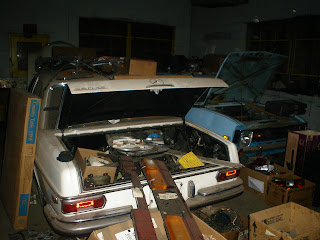
Off and on for the last 5 years I've worked for a local foreign car mechanic in Erie, PA named Wolfgang. As his name would suggest, he really is a stereotypical German mechanic. He's a notorious pack rat and has been collecting cars, car parts, and parts cars for the last 30 years. In his shop, he has an area he refers to as "behind the curtain" (though to be correct, one has to say 'behind ze curtain') This is where he keeps most of the 'good' junk. It's really just a big room sepparated from the main work area thats filled with Mercedes, VW, Audi, Volvo and Jaguar parts among other things. Wolfgang's entire shop could take up many posts in this blog, so at this point, I'm only going to show these pictures of some of the non-running cars stored in there:

The Audi 5000 Quattro Turbo that's burried under these boxes, is actually pretty clean aside from its thick layer of dust. The story goes on this car that it had a major front suspension issue (hence the missing wheel) and the customer opted to give Wolfgang the car rather than pay for the costs. Last registered in 1995. This car could be cleaned up, repaired and be rather nice, unfortunately late 80's Audi sedans haven't made much of an impact on the collector car market and it's probably not worth the effort.

This 1971 Opel Kadett Combi was last registered for road use in 1992. Since then, it's been a semi-permanent fixture in the back room. It cargo space is filled with parts for other cars. It may seem to be in a rather sorry state - and essentially it is, but it really wouldn't take much to get it running and driving again. The body appears to be pretty solid and, to quote the name of this site, it ran when parked.


Also of note is this early 70s Mercedes Benz 280 SE. It's in need of some body work, but the rest of it appears to be pretty decent. It sports a red MB-Tex interior, and is powered by the 6 cylinder engine. This could definately be a worthy canditate for a modest restoration. Im not aware at the moment how this Benz came to rest in the back room. As you can see, it's currently primarily a storage box and table.